On the surface, I am a bad candidate for Google+. For one thing, I was a slow adopter to Facebook, grudgingly creating my account only when I moved internationally so as to have a way to keep up with my friends. For another, I look like a walking advertisement for Apple, with my Macbook, iPad, and iPhone never far from sight. Finally, I am already absolutely overwhelmed by an incoming torrent of emails, twitter, and Facebook notifications, and the last thing I want is another fucking website to be checking.
Therefore, when my friend at Google sent me a "Field Trial invite" last month, I glared at the email and stubbornly ignored it. Then, predictably, early adopters such as Ben and Stephen -- no wait, sorry, that should be Ben and Stephen, found their way on the site and so I too, did the inevitable. Within 30 minutes of playing around, I can already say I am hooked and I hope it takes off. It's fast - the way Facebook used to be, before it got cluttered with plugins, addons, and ads. Unlike Buzz and Wave, it's well-designed, user-friendly, and it works. It has the potential to replace both Facebook and Twitter, and very possibly LinkedIn as well. In fact, if any sort of critical mass gets on it, then I will want the G+ bar wherever I browse - and unlike Facebook, Google can actually make this a reality in the short-term future. Furthermore, unlike Facebook, the privacy and sharing on almost every item you post is easy to understand and completely within your control.
In some ways, it's almost unfair. Lists on Facebook serve the same purpose as Circles on +, and I use Lists extensively. But by the time Lists were implemented, I already had over 500 friends. There is simply no easy way to go back through my friends and sort them into lists hours of tedious clicking. Facebook compounds the problem by purposefully making privacy settings obscure and difficult to control. On G+, every new friend gets added to the right Circle with no extra clicking. The process is fast and intuitive.
Also, Facebook kind of went about it ass backwards. It started as a closed environment, where people felt safe and secure posting their information. Then, with each major update to the site, privacy is loosened and a ruckus is raised by users who feel violated, but have nowhere else to turn. Now, there is an alternative, and everyone already knows Google's purpose is to serve up ads, so there's no big surprise there. I am glad Google has refused to give up on social, and they continue to take chances and commit to having a presence.
Facebook's strategy worked well for them, but every strength is a weakness on the flipside, and G+ does a good job of exposing those vulnerabilities. This will be a great battle between these two great tech giants - competition is always good for consumers. G+ is a pleasure to use, and I look forward to watching how Zuckerberg and Sandberg plan to strike back.

Tuesday, July 5, 2011

Saturday, June 18, 2011
Favorite line from Colbert's speech
Life is an improvisation. You have no idea what's going to happen next. And you are mostly just yanking ideas out of your ass as you go along. And like improv you cannot win your life.
Watch Stephen Colbert's 2011 NU Commencement Speech in it's entirety here.
Watch Stephen Colbert's 2011 NU Commencement Speech in it's entirety here.
Wednesday, June 8, 2011
Oh how things change
Courtesy of my friend:
"At first people started talking to them selves, or at least it seemed that way, and then you realised that actually they had bluetooth ear pieces in - now I just saw what I thought was some one having an epileptic fit on stage, turns out they were playing a game on the Xbox using the kinect controller..
What a strange society it is that our kids are going to inherit."
Friday, June 3, 2011
Bye Bye B-school #1
Rather than attempt (and fail) to give a comprehensive post reflecting on my 2 year journey in business school as it comes to a close, I want to first direct you to some great writing done by my predecessors and fellow Kellogg alumni, on "What it's for," and "Was it worth it?"
As I grapple with my last set of finals (likely ever) this week and slowly knock out my remaining assignments, I would like to blog more, as recently I feel I have let several fleeting streams of thought escape me by failing to sit down and work through them. The goal is to do a series of posts (titled Bye Bye B-school) so I don't feel so compelled to try to get it all out at once!
"There is no truth. There is only perception."
- Gustave Flaubert, 17th century author of "Madame Bovary"
Life is only a series of perspectives. Unsurprisingly, there are many perspectives to take on this very subject. For example, one aspect is that there are two sides to each story. Another is that the more you learn, the less you realize you know. My favorite wording of this is from Harry Kraemer, who describes that as you improve in something, you feel like you're going from a 6, to a 7, to a 8... but around the time you get to 8 or maybe even 9, you suddenly realize that the scale wasn't out of 10, as you originally thought, but instead 20. My personal learning has been around learning to let go the "one right answer" mentality I have held for the majority of my (Asian-learning-style inspired) life, and instead embrace the ambiguities, complexities, vagaries and downright messiness of real-world problems. Kellogg's group culture has been a strong antidote for me; we all know it is important as leaders to consider each individual perspective, but how many of us can keep that in mind when the discussion heats up and we know someone else to be wrong? When I believe I am right, I can feel my back arched and eyes flashing, and I will use angry rhetoric, extreme analogies, and an unrelenting cascade of arguments to prove my point. I can't pretend that I'm now suddenly a collaboration-loving snugglebunny in groups, but I do feel much more self-aware in group situations and cognizant that I need to take off the blinders. This applies not only to groups, but also within a company, realizing that there are different departments with different goals, or even within an industry, seeing how the different companies fit together because of different strategies. On the opposite end of the scale, in personal situations, I am much more aware of conflict, looking beyond the surface issues to diagnose the origin. Different perspectives can be traced to different values, experiences, or beliefs, and if conflict cannot be resolved outright than at least it can be understood and tolerated comfortably. This applies even to conflict within myself; when I am confused, or frustrated, remembering to step outside of my present perspective and find a new one is the surest route to getting back on track.
"Were I to wait perfection, my book would never be finished."
- Tai T'ung, 13th century author of "History of Chinese Writing"
There can be efficiency in "good enough." We hear frequently in life about the 80/20 rule. But following onto the previous point that there is no constant, when everything is only a matter of perspective, it makes sense not to commit yourself so far down one path that there can be nothing else. Because life changes. My perspective will change. My friends can attest to my tendency to veer to extremes, and one consequence is I either dive into something with 100% zeal, or if something isn't working out right I drop it like a wet rag. Just these last few days, spurred on by this article with great advice on what works in startups, I have begun seeing how this "good enough" principle can apply not just in today's fast moving tech world and software development, but my personal life and projects. This is not to say that things shouldn't be done properly, and I know my personal perfectionist inclination (shared by many b-school types) will always be pushing me to get as good of a product as possible. My goal is to stay motivated and committed on the war, knowing some battles will be lost along the way, and although I won't always get everything optimized, it will have to be "good enough."
This dovetails nicely into another lesson from Harry Kraemer: The job of a leader is only two-fold:
Every man builds his world in his own image. He has the power to choose, but no power to escape the necessity of choice.
- Ayn Rand, author of "Atlas Shrugged"
Make choices explicitly. So if we accept that life is a series of perspectives, and that a lot of the time we do not have the power to, nor should we try to, control everything, then what follows is that all we can control are the choices we make. Many times when we feel we have our backs against the wall, it is easy to forget that there is always a choice. Not seeing the choice and going ahead is failing to take into account the other perspective. Knowing there's a chance you may fail, but having weighed the consequences and making the choice explicitly, there are no regrets. I didn't mean to make this post all about Kraemer, but making explicit vs. implicit choices is something else that he drove home in his Managerial Leadership class. It is easier to make a choice implicitly, because there is an excuse if things don't turn out as planned. Making a choice explicitly can be scary, because it acknowledges that you have control, and there is a power and associated responsibility that comes with the control, where if things don't turn out as planned then it is your fault. Part of the problem is being able to differentiate a poor decision from a poor outcome; often in life there will be good decisions that result in poor outcomes. But only by making choices explicitly can we ensure that our actions are aligned with our values, that that what we're doing makes sense and is actually the right decision for us. Making choices explicitly forces you to anticipate the ensuing result, to consider the multiple perspectives, so that we aren't surprised by an outcome. So for example, it's one thing to tell yourself you're going to get around to mowing the lawn, and keep putting it off. It's another to recognize that yes, someone else could say you should mow the lawn, but that you are prioritizing going out with friends, cleaning the house, and other hobbies over it. Even if the outcome is the same (the lawn doesn't get mowed), by making the choice explicitly, rather than feeling guilt and anxiety over not mowing the lawn, you recognize that you have made the choice, and the consequence of the choice is an unmowed lawn. And if you don't have more important things that take priority over the lawn, then why the hell haven't you mown it already? No reason not to anymore, right?
Okay, that's it for now. Up and at 'em in 4 hours for yet another final presentation, whee.
As I grapple with my last set of finals (likely ever) this week and slowly knock out my remaining assignments, I would like to blog more, as recently I feel I have let several fleeting streams of thought escape me by failing to sit down and work through them. The goal is to do a series of posts (titled Bye Bye B-school) so I don't feel so compelled to try to get it all out at once!
"There is no truth. There is only perception."
- Gustave Flaubert, 17th century author of "Madame Bovary"
Life is only a series of perspectives. Unsurprisingly, there are many perspectives to take on this very subject. For example, one aspect is that there are two sides to each story. Another is that the more you learn, the less you realize you know. My favorite wording of this is from Harry Kraemer, who describes that as you improve in something, you feel like you're going from a 6, to a 7, to a 8... but around the time you get to 8 or maybe even 9, you suddenly realize that the scale wasn't out of 10, as you originally thought, but instead 20. My personal learning has been around learning to let go the "one right answer" mentality I have held for the majority of my (Asian-learning-style inspired) life, and instead embrace the ambiguities, complexities, vagaries and downright messiness of real-world problems. Kellogg's group culture has been a strong antidote for me; we all know it is important as leaders to consider each individual perspective, but how many of us can keep that in mind when the discussion heats up and we know someone else to be wrong? When I believe I am right, I can feel my back arched and eyes flashing, and I will use angry rhetoric, extreme analogies, and an unrelenting cascade of arguments to prove my point. I can't pretend that I'm now suddenly a collaboration-loving snugglebunny in groups, but I do feel much more self-aware in group situations and cognizant that I need to take off the blinders. This applies not only to groups, but also within a company, realizing that there are different departments with different goals, or even within an industry, seeing how the different companies fit together because of different strategies. On the opposite end of the scale, in personal situations, I am much more aware of conflict, looking beyond the surface issues to diagnose the origin. Different perspectives can be traced to different values, experiences, or beliefs, and if conflict cannot be resolved outright than at least it can be understood and tolerated comfortably. This applies even to conflict within myself; when I am confused, or frustrated, remembering to step outside of my present perspective and find a new one is the surest route to getting back on track.
"Were I to wait perfection, my book would never be finished."
- Tai T'ung, 13th century author of "History of Chinese Writing"
There can be efficiency in "good enough." We hear frequently in life about the 80/20 rule. But following onto the previous point that there is no constant, when everything is only a matter of perspective, it makes sense not to commit yourself so far down one path that there can be nothing else. Because life changes. My perspective will change. My friends can attest to my tendency to veer to extremes, and one consequence is I either dive into something with 100% zeal, or if something isn't working out right I drop it like a wet rag. Just these last few days, spurred on by this article with great advice on what works in startups, I have begun seeing how this "good enough" principle can apply not just in today's fast moving tech world and software development, but my personal life and projects. This is not to say that things shouldn't be done properly, and I know my personal perfectionist inclination (shared by many b-school types) will always be pushing me to get as good of a product as possible. My goal is to stay motivated and committed on the war, knowing some battles will be lost along the way, and although I won't always get everything optimized, it will have to be "good enough."
This dovetails nicely into another lesson from Harry Kraemer: The job of a leader is only two-fold:
- Prioritize
- Allocate resources
Every man builds his world in his own image. He has the power to choose, but no power to escape the necessity of choice.
- Ayn Rand, author of "Atlas Shrugged"
Make choices explicitly. So if we accept that life is a series of perspectives, and that a lot of the time we do not have the power to, nor should we try to, control everything, then what follows is that all we can control are the choices we make. Many times when we feel we have our backs against the wall, it is easy to forget that there is always a choice. Not seeing the choice and going ahead is failing to take into account the other perspective. Knowing there's a chance you may fail, but having weighed the consequences and making the choice explicitly, there are no regrets. I didn't mean to make this post all about Kraemer, but making explicit vs. implicit choices is something else that he drove home in his Managerial Leadership class. It is easier to make a choice implicitly, because there is an excuse if things don't turn out as planned. Making a choice explicitly can be scary, because it acknowledges that you have control, and there is a power and associated responsibility that comes with the control, where if things don't turn out as planned then it is your fault. Part of the problem is being able to differentiate a poor decision from a poor outcome; often in life there will be good decisions that result in poor outcomes. But only by making choices explicitly can we ensure that our actions are aligned with our values, that that what we're doing makes sense and is actually the right decision for us. Making choices explicitly forces you to anticipate the ensuing result, to consider the multiple perspectives, so that we aren't surprised by an outcome. So for example, it's one thing to tell yourself you're going to get around to mowing the lawn, and keep putting it off. It's another to recognize that yes, someone else could say you should mow the lawn, but that you are prioritizing going out with friends, cleaning the house, and other hobbies over it. Even if the outcome is the same (the lawn doesn't get mowed), by making the choice explicitly, rather than feeling guilt and anxiety over not mowing the lawn, you recognize that you have made the choice, and the consequence of the choice is an unmowed lawn. And if you don't have more important things that take priority over the lawn, then why the hell haven't you mown it already? No reason not to anymore, right?
Okay, that's it for now. Up and at 'em in 4 hours for yet another final presentation, whee.
Sunday, April 3, 2011
Crap.
On an independent study last quarter, the professor was unable to give me feedback during the quarter and now, after grading my final project, has given me the choice of
1) take a B now
2) make changes (estimated at 15-20 hours of work) to receive an A
Honestly, I don't have the 15-20 hours to put in this quarter. In fact, cost benefit analysis tells me clearly to take the B and to continue bailing out (ladling water out) rather than take on more water on an already sinking ship. I am going to sleep on it before responding, but I already know I will be making the changes. There is something wrong with my brain. This is why I wish I knew more about psychology, so I could understand why I make irrational choices.
There is no right answer
I got really annoyed tonight because my roommate needlessly reran the dishwasher, even though the contents were already clean after I ran it yesterday.
While that is certainly laziness on his part for not checking, the hissy fit I felt like having was disproportionate to the offense. (Luckily, he is out, so I had time to calm down and probably now won't even mention it)
This either means 1 of 2 things.
1. I am more suited to live by myself (no doubts here) and I should in the future to maintain my Zen.
2. It is good for me to live with someone else, to practice putting things in perspective and thinking from another person's point of view, and I should get a roommate in the future to learn to be a better person.
Love how depending on your opinion and/or perspective, either one can be right. But they are complete opposites.
Sunday, March 6, 2011
Productivity slump
- went out drinking on Friday night
- the weather was crappy, automatically reducing motivation
- had coffee with the ex - never a good idea if you want to focus on work
- I cooked all my meals yesterday, which takes a substantial amount of time
But I think there are 2 primary reasons I am frustrated by how yesterday went.
- I haven't scheduled any me-time. Even on days where I do no schoolwork, I usually am trying to tackle things off my to do list (including yesterday, when I went to get my battery replaced at the Apple store and then grocery shopping). Unsurprisingly, my brain just shut off yesterday and no matter how long I sat in front of the computer, I managed to find other ways to spend my time. The Making of a Corporate Athlete, a great article introduced to me by Orlando, talks about how just like physically, muscles need rest cycles between workouts to be order to grow and stay healthy, mental and emotional energy requires rest cycles to have sustained high performance. In the future, I am going to try to build in a full day of restoration every 2 or 3 weeks, devoted to something fun which I actually enjoy doing, which is preferable to spending a whole day unsuccessfully trying to work and constantly kicking myself for not being able to. Luckily, I have a few weeks of break coming up where I plan to do nothing but sleep, eat, exercise, and read. I can't think of the last time I curled up on the coach with a musty tome borrowed from the library, and that used to be one of my favorite activities in the world.
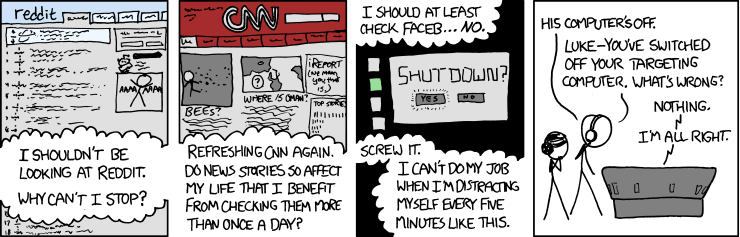
- There are just too many frickin distractions. I am sorely tempted to delete my Facebook account. I was a late adopter to Facebook, only creating my account once I moved internationally so I could keep up with my US based friends. I can see the value in maintaining weak ties, but I think it has gotten to the point where I miss the days when friends would call each other up to find out what's going on, rather than just following & commenting on Facebook. It is far too easy to waste hours surfing through old friends pages and pictures, and similarly, as my Twitter stream velocity increases, clicking one link too often leads to me coming to my senses 45 minutes later, having meandered my way through an interesting online discussion on a current event or technological trend. Even my friends, whom I love dearly and cherish the opportunity to stay in touch with, chat with me on messengers with the inevitable result of losing focus on work. Now, the majority of the time I have been exercising self control by closing all extraneous applications, but when I am in a productivity funk like yesterday, it becomes a pathological impulse to let each distraction carry me away. The author of xkcd, in the above comic, talks about how he created not only a 30 second delay between loading of web pages and chat clients, but also restricted his OS so that multiple programs could not be run at once. This is a fairly hard line to take, but I can see the need and have yet to find my own methodology to truly take control of this issue.
Tuesday, March 1, 2011
Dean Blount & Kellogg's next 7 years
Just got back from a lunchtime presentation by Dean Sally Blount, on her plans and thoughts on what the future held in store for Kellogg. I didn't take any notes, but from memory, here are my takeaways:
The new building is coming. It will be an ambitious undertaking, planning to cost ~$300M, with a target opening in Fall of 2016.
Kellogg's administration is undergoing a marked restructuring. As such, there are multiple senior management positions currently being recruited. One will manage all MBA programs, one which manages all career services, and another will manage all executive education ... all roles will report directly to the Dean. This is a marked change from now, where the full-time MBA program operates more or less separately from the part-time MBA program, and the career services are rather silo'ed as well. Basically, how it seems to me is the matrix (as far as reporting structure goes) is being rotated on its side.
Explicitly added as a reason behind the restructuring is the Dean will be spending a lot of her time on fundraising. A LOT. Therefore, it is particularly important for her to have a strong team of senior management.
Kellogg is starting the process of undertaking a number of strategic initiatives. For some reason, this always plays second fiddle to the building, but I feel this area is notably more important. Unfortunately, the timeline for this will extend 5-7 years as well, but Dean Blount gave her perspective on several topics here.
Here are my thoughts:
I've been reserving judgement about the Dean so far, and this was a great opportunity to see her in action, up close and personal. Here are my thoughts coming away from the session:
The new building is coming. It will be an ambitious undertaking, planning to cost ~$300M, with a target opening in Fall of 2016.
Kellogg's administration is undergoing a marked restructuring. As such, there are multiple senior management positions currently being recruited. One will manage all MBA programs, one which manages all career services, and another will manage all executive education ... all roles will report directly to the Dean. This is a marked change from now, where the full-time MBA program operates more or less separately from the part-time MBA program, and the career services are rather silo'ed as well. Basically, how it seems to me is the matrix (as far as reporting structure goes) is being rotated on its side.
Explicitly added as a reason behind the restructuring is the Dean will be spending a lot of her time on fundraising. A LOT. Therefore, it is particularly important for her to have a strong team of senior management.
Kellogg is starting the process of undertaking a number of strategic initiatives. For some reason, this always plays second fiddle to the building, but I feel this area is notably more important. Unfortunately, the timeline for this will extend 5-7 years as well, but Dean Blount gave her perspective on several topics here.
- Improving/expanding Kellogg's core competencies, which she sees as:
- Providing the best education for students
- Creating the best environment for top professors to conduct research
- Improving [my add here: sorely needed] alumni engagement
- Leveraging corporate partnerships
- Kellogg's unique culture, and how it can be managed to continue to be and grow as a competitive advantage
- Having a truly global presence; as it is unlikely in the next few decades Chicago will be a top 10 city globally (unfortunate but probably true), determining the best way for Kellogg to have a presence in those cities
- Consistent, meaningful, and compelling Kellogg branding
Here are my thoughts:
I've been reserving judgement about the Dean so far, and this was a great opportunity to see her in action, up close and personal. Here are my thoughts coming away from the session:
- She is clearly passionate about her job, and this passion comes across when she speaks. This also makes her seem very genuine. This is a great plus.
- It is particularly difficult for a woman to be a good public speaker in what is still the man's world of business, academia, and particularly business academia. She is undoubtedly smart, but as the face of Kellogg I hope her style improves to sound more cogent and confident. I hope I will have the opportunity to take speech coaching in the future, as if even the Dean of a top business school can use improvement (things like vocal intonation, sentence structure & flow) then I have a long way to go.
- She has a tendency to make bold pronouncements, which follows along her passionate style. There were several times during the talk she looked to, referenced and apologized to the PR manager who was standing by, for treading on dangerous ground in relation to what is public knowledge.
- She is looking to place bold bets on the future of business research and education in order to ensure Kellogg remains a leader of business education. I imagine this fact, along with her style, probably places her radically at odds with a large portion of what still remains a conservative (some might say stodgy) and risk-averse world of academia. I would be willing to bet that between floors 2-7 of Jacobs, she is an extremely polarizing figure.
- She referenced the glory days of Dean Don Jacobs, and clearly hungers for Kellogg to be back on the cutting edge, as it was when she attended Kellogg for her PhD. This is likely the driving force for her need to shake things up. Whether or not she will succeed, it is far too early to tell, but I certainly am rooting for her.
Friday, February 18, 2011
Moment of uncertainty
I started tweeting this, and realized it was way more suited for a blog post.
My last ever round of course bidding just finished, which leaves me feeling wistful and slightly anxious. There are increasingly more and more signs appearing indicating our time here at Kellogg is drawing to a close. As I read through the Facebook stream of people bragging of their 3-day-week schedules and minimum requirements, I realize what a contrast it is with my schedule, which will have 6 classes and the absolutely unshakeable need to audit a 7th. I'm also going to the gym multiple times a week, and just started a hip hop dance class. I maintain a firm sleep schedule of 7-8 hours a night.
I had coffee with a 2010 alum today, who told me she both admires and feels sorry for me, for taking on so much. She couldn't understand it - she spent her Spring quarter drinking wine and hanging out with her friends, a situation I'm understandably envious of. I, on the other hand, seem to have chipped away at my social life down to the occasional dinner or party, and I've given up on rebuilding a tolerance to alcohol. The fact I'm writing this during TG is probably a sign.
I enjoy people. I like making friends, and spending time with them. But I also have this overpowering need to achieve, to make something of myself. I remember when I was in college, taking a full load of classes through 4 straight summers in a row, how everyone told me I should "stop and smell the roses." I didn't listen then, and sometimes, I do regret not taking the time to explore, travel, savor a little more. But yet, I find myself falling into the same pattern again now, 8 years later. I'm not even sure what it is I'm chasing so hard, I just know I'm running as fast as I can. If I'm honest, deep down I'm a little terrified that when I start my full time job, I'll get comfortable, fall into a routine, and stagnate, which is probably driving some of my current behavior. I just know this urge is so strong, it's not a choice - it's a compulsion.
And so I find myself facing another quarter of obsessively planning out my time in half hour increments. I can truthfully say I have succeeded in upping my productivity by ruthlessly cutting out anything I consider fat*. I'm going to try to make the most of my last quarter, by taking 6 or 7 classes, each of which I have discrete goals for. I'm planning on using Spring vacation as a health (and mental health) break, to eat right, read books, and work out every day. I'm also giving up my last vacation post graduation to take an intensive language class (8 hrs/day, 5 days/week). And it's only when I meet with other people that I get hit with a moment of uncertainty... is it really so weird to prioritize work > mindless fun?
*Note: Seriously, fun is NOT considered fat - I hosted a great Superbowl party, I have had dinner twice this week with old friends, I'm going to Charity Auction Ball tomorrow, and have a great weekly breakfast with a disreputable lot. Furthermore, I am also finding time for little side projects, ie. I've been cooking from scratch 2-3 times a week, which is really enjoyable. I guess in the same way Kraemer says we shouldn't let other people define success for us, I've stopped letting others define what fun is to me.
So yes, I have my moments of uncertainty. I have my worry that maybe I'm missing the point of business school, which is to create this far-flung, expansive network by going out with/getting sloshed with a constantly rotating set of people. But then, it passes. I came to business school to find a career. I still have no clue what I want to be when I grow up. Instead, I may have found myself. And that is infinitely more valuable.
Wednesday, February 9, 2011
the duality of acceptance
(this post is one of my self reflection papers for MORS468 Managerial Leadership with Harry Kraemer, a class I highly recommend)
There are two traits that are universal among people. First, there is the fundamental need to be accepted by others. This can manifest itself in a variety of ways – the need to be included, popular, liked, respected, etc… but the underlying premise is the same. Secondly, there is an internal struggle for self-acceptance. One of the biggest surprises of attending business school is the widespread extent to which so many talented and accomplished young men and women suffer from low-esteem. Outwardly, everyone is brimming with confidence, but the majority of people I have gotten close to have expressed many self-doubts, the very same ones that I harbor and make me feel inadequate.
Humans are fundamentally social animals, which births the instinctual need to be accepted by others. This need drives people to change themselves and mold themselves to a certain image. This does serve an important function in society. It is the need to be accepted by others which drives the following of communal norms, such as ethics. But it is also this need which drives “peer pressure,” a term used almost exclusively in a negative context.
A great portion of leadership coaching talks about honoring your needs. After all, whether recognized or not, consciously or subconsciously, people spend a great deal of effort getting needs met. This is true of the need to be accepted by others. People choose how they look, walk, and talk based on perceived reaction from those around them. Even in this class, we learn to mold ourselves into better leaders, as based on the somewhat arbitrary definitions of others.
However, even as we are bombarded by messages to change ourselves to be accepted by others, we are also told to “stay true to ourselves.” In fact, a major aim of modern psychotherapy is to teach patients self-acceptance. Being kind to yourself means accepting yourself for the way you are – hopes, ambitions, strengths, weaknesses, flaws, warts and all. Herein lies the ultimate contradiction. We crave acceptance. How many teenagers, nay, even grown adults change their appearance, their personality, their life situation to win the approval of others? Yet we also need to accept ourselves – and that means as is. You can’t say, “I’d love myself if only I was 10 lbs skinnier” – that is almost certainly not true self-acceptance.
Is it possible to honor the need to be accepted by others while still accepting ourselves? Perhaps the most self-assured people can shrug off the pressure to conform to expectations, but how many of us fall into that category? The rest of us yearn to be a part of a group, to be admired by others. I think we do need to honor our need, to an extent. For example, this may involve changing yourself for the better, although what is considered better? Getting off drugs? Of course. Quitting smoking? Almost certainly. Losing weight? Perhaps. Getting plastic surgery? Now we’re getting into dicey territory…
At the same time, we should strive to be comfortable in our own skin. That means understanding that everything is a process, even self-acceptance. We should treat ourselves no better or worse than we would a good friend – being our own champion when we strive and our own supporter when we stumble, as people inevitably do. In an ideal world, we would be accepted by everyone, including ourselves. Unfortunately, in the real world, you will never be able to please everyone. You will also battle low self-esteem at some points. But the world is hard enough, without being your own enemy. We are taught that being a leader is about prioritizing and allocating resources. Why should acceptance be any different then? Prioritize and allocate resources against the various constituents for acceptance: acquaintances, friends, family, and remember, the number one priority for acceptance should be yourself.
Sunday, January 23, 2011
For the second time this quarter, it dawned upon me how much happier I am this quarter than last, and I think it is for several reasons.
- I feel like I am learning something from and am actively engaged in all of my classes
- I am sleeping 8-9 hrs a night, instead of 6-7
- I am moving on past a crappy relationship
- I give myself one day every week to be at home, alone
- I feel incredibly productive all around
- I am kinder to myself when I make mistakes
- I don't guilt trip myself (or am doing it less) for not living up to unrealistic expectations
What's amazing is I don't think I've taken on any less - I'm still taking 5 classes, one of which is a significant side project which just happens to be the most challenging thing I've ever done. I am definitely outside my comfort zone in a few areas, and am also giving up to 10 hours of case prep every week. But for some reason life just seems to be moving at a more manageable pace, where I am giving myself enough time to sleep and also focusing on getting discrete projects or tasks done. This makes me realize a few things - how much time I wasted last quarter tormented by a bad relationship, that I should dare to reduce what I take on because the benefits are tangible, and how important it is for me to find meaning in what it is I'm doing.
Part of being more self-reflective this quarter means (omg so fuzzy) being more in touch with my feelings, so I have definitely have had days of melancholy. Some of my best friends are on exchange this quarter, so I miss having them around and there's still lingering sadness over a few things I regret or wish I could change. But I am also filled with optimism - for example, one of the areas I have pushed myself in is networking with more people, both reaching out to strangers and staying connected with contacts from my past. The response, support, and advice I have gotten has been inspiring. I am glad I am taking the time to look inward because it gives me perspective, guidance, and the strength to face the outside world.
Thursday, September 9, 2010
Random musings
When I was young, I flew a lot. The only time I ever got scared was during landings, because I did not like the sensation of sinking lower and lower. Then, one flight, a nice gentleman sitting next to me informed me that I had nothing to worry about, because if a problem were to occur on an airplane, it was 5 times as likely to occur during takeoff than landing.
Now, I am terrified of both takeoffs and landings.
Thursday, June 3, 2010
Cannot believe it
That this is the last week of my first year of Kellogg. It is so unreal, and it definitely has not fully hit me yet. It's been a good (albeit busy) quarter, but I wanted to wish congratulations to all of the incoming class of 2012 and best wishes to all the 2010 graduating class who are moving onto to their next grand adventure, and even the 2011 who are off onto their summer escapades.
And now, some quotes I've been thinking about today:
A good deed is never lost. He who sows courtesy, reaps friendship; he who plants kindness, gathers love; pleasure bestowed on a grateful mind was never sterile, but generally gratitude begets reward.
- St. Basil (329-379, Bishop of Caesarea)
Renunciation is not getting rid of the things of this world, but accepting that they pass away.
- Aitken Roshi
If only I could throw away the urge to trace my patterns in your heart, I could really see you.
- David Brandon (Zen in the Art of Helping)
- St. Basil (329-379, Bishop of Caesarea)
Renunciation is not getting rid of the things of this world, but accepting that they pass away.
- Aitken Roshi
If only I could throw away the urge to trace my patterns in your heart, I could really see you.
- David Brandon (Zen in the Art of Helping)
Thursday, May 6, 2010
In the spirit of Patrick English
I fucking love Kellogg professors.
And yes, the profanity is really necessary. I've never been more impressed by a bunch of teachers, who are razor-sharp smart, fun & entertaining, and genuinely care about their students. Now of course there is variance among the pool, but the number of professors who stand out at Kellogg I do feel is larger than average.
For instance, today, Schummer and McKeon, two Decision Analysis profs, gave a 2 hour long session on card-counting. This was not a theoretical exercise. These two professors actually frequent Vegas together as a card-counting team for fun (and profit), and have been quite successful, if their life-time bans from multiple casinos are any indication. In fact, notice the title of their handout.
We just finished up Special K!, a 30-year old Kellogg tradition that is a revue show that encompasses musical, dance, and theatrical talent with a humorous (hysterical, if you take my biased opinion) view of Kellogg life, soaked in a strong dash of Kellogg culture. The show was a raging success, judging on the feedback we have gotten, and part of what made it so special was the outstanding level of participation by professors. In particular, we had reached out to a number of (quite rockstar) professors, who obviously could have spent their time in many other ways than hanging around us and rehearsing lines to sing with us. Furthermore, other professors were willing to appear in our video shorts, and an even larger number bought tickets to the show, brought their family, emailed out to their students in an outstanding show of support. Yes, Kellogg professors do great research and teach well, but they also have no qualms about poking fun of themselves, have great senses of humor, and are 9 times out of 10 willing to go the extra mile for their students. That's what makes them top notch.
Tim Calkins writes a fantastic blog about happenings in the marketing world, Gad Allon (current Professor of the Year, the highest ) tweets to his students (quote of the day: "Real men use matlab.") and David Besanko sends out relevant, thought-provoking emails to his students on current affairs for no reason other than to stretch our thinking and challenge our preconceptions. I'm lucky enough to be taking Calkins and Besanko this quarter (both HIGHLY recommended) and hopefully I will be able to take Allon's OpStrat next year.
Just wanted to shine a light on something probably less often talked about Kellogg. We have an amazing, fun, student-led culture with clubs & activities up the wazoo, but we have faculty worth going to class for too.
And yes, the profanity is really necessary. I've never been more impressed by a bunch of teachers, who are razor-sharp smart, fun & entertaining, and genuinely care about their students. Now of course there is variance among the pool, but the number of professors who stand out at Kellogg I do feel is larger than average.
For instance, today, Schummer and McKeon, two Decision Analysis profs, gave a 2 hour long session on card-counting. This was not a theoretical exercise. These two professors actually frequent Vegas together as a card-counting team for fun (and profit), and have been quite successful, if their life-time bans from multiple casinos are any indication. In fact, notice the title of their handout.

We just finished up Special K!, a 30-year old Kellogg tradition that is a revue show that encompasses musical, dance, and theatrical talent with a humorous (hysterical, if you take my biased opinion) view of Kellogg life, soaked in a strong dash of Kellogg culture. The show was a raging success, judging on the feedback we have gotten, and part of what made it so special was the outstanding level of participation by professors. In particular, we had reached out to a number of (quite rockstar) professors, who obviously could have spent their time in many other ways than hanging around us and rehearsing lines to sing with us. Furthermore, other professors were willing to appear in our video shorts, and an even larger number bought tickets to the show, brought their family, emailed out to their students in an outstanding show of support. Yes, Kellogg professors do great research and teach well, but they also have no qualms about poking fun of themselves, have great senses of humor, and are 9 times out of 10 willing to go the extra mile for their students. That's what makes them top notch.
Tim Calkins writes a fantastic blog about happenings in the marketing world, Gad Allon (current Professor of the Year, the highest ) tweets to his students (quote of the day: "Real men use matlab.") and David Besanko sends out relevant, thought-provoking emails to his students on current affairs for no reason other than to stretch our thinking and challenge our preconceptions. I'm lucky enough to be taking Calkins and Besanko this quarter (both HIGHLY recommended) and hopefully I will be able to take Allon's OpStrat next year.
Just wanted to shine a light on something probably less often talked about Kellogg. We have an amazing, fun, student-led culture with clubs & activities up the wazoo, but we have faculty worth going to class for too.
Wednesday, January 27, 2010
(Chinese) New Year's Resolution (effective immediately)
I don't really believe in New Year's Resolutions. It seems really pointless to me to wait until a specific date to try to improve yourself. Therefore, when I come up with a change I'd like to initiate in myself, I want to start right away, and don't bother announcing or labeling it as a resolution. However, with this particular item, I want the world at large to help, so in honor of the next upcoming New Year, I am labeling it my (Chinese) New Year's Resolution:
I resolve to be friendly to everybody. This means a genuine smile and greeting to people I know, or who greet me.
The reason this comes up is because 1. I'm trying to shield myself from the crankiness and frustration I feel creeping in from the ongoing recruiting and 2. I know at even my 2nd quarter, I am starting to develop impressions of other people, suppositions of their feelings towards me, and expectations (both positive and negative) of their future behavior. In other words, I find myself writing people off. This is good from a time management perspective - why waste time and valuable hurt feelings on people you think have already written you off or with whom you have no meaningful connection. However, I think I'd like to retain my youthful optimism a bit more. Part of this is I'm curious as to how strong the self-fulfilling prophecy really is, and part of this is just me wanting to be an overall better person.
So there you have it. If you walk by me and I don't smile and say hi, you are fully entitled to kick me in the crotch.
Consulting interview preparation process
Quick note from the trenches (because yes, it's a warzone out here):
I wish I had the time or the energy to do a better deconstruction of the consulting recruiting process, but as usual, one of my fellow bloggers has done a fantastic job of summing up the experience to date.
So I wanted to post one of the first "regrets" I've had (or better put, "something I wish I had known"). In true wannabe consulting style, I've decided to present the information in chart format.
 Formal networking comprises of company presentations, meet and greet nights, and dinners. Informal networking is time spent in coffee chats, composing emails reaching out to alumni, and informational interviews via phone or person. Interview preparation includes case and fit preparation.
Overall, Orlando is right - the amount of time and energy it takes to get through this is hard to fathom. There is no way I can give an accurate number, but if pushed to guess I would say I have spent over 150 hours on the overall process, and this is on top of a full load of classes and a spate of extracurriculars. I also think I am probably around the middle of the distribution, I know people who have put far more time, effort, and thought into this process than I have.
Looking at my pie charts, it seems like a no brainer. "Duh Cow, you should have put more time into interview prep." What is harder to convey though, is the swiftness with which interviews descend upon you after your return from winter break. If you consider that the networking components stretch out across 3 months while the interview prep basically happens in 2 weeks time, it becomes easier to see how this happens.
I'm not sure that there is one right solution, because many people give the advice to do no prep prior to or during winter break. However, here are some thoughts of mine:
- The CMC places FAR too much emphasis on networking for people who are hardcore about consulting. The main purpose of networking is to get on the closed list, and consulting companies interview massive numbers of candidates. If you have a reasonably strong background and have made some effort at reaching out, there are diminishing returns to continuously meeting new people. Instead, meet and cultivate a few trustworthy contacts who will give you the inside scoop on the firms.
- Even if you don't make the closed list, the bidding for the open spots (of which there are many) for the major firms goes for some nominal sum (I think ~60pts this year). Bid freely - for reference, I have yet to use any of my 800 points.
- Get to know yourself over break. I know it's painful and it sucks, but be able to explain the bullets of your resume in detail and know (and be able to articulate) the few key questions: What's your story? Why consulting? What are your strengths and weaknesses? I know I would have been well served if I had taken the time to do this over break, instead of sitting on my couch, watching football while eating Cheezits. Fit still seems to be an afterthought to case, in terms of both advice given by the second years and preparation made by the first years. This is a huge mistake.
- Although the number of cases varies significantly by person, there is value to doing enough of them that you have seen if not all then the majority of different "types" of cases, ie. profitability, growth, new market, m&a, supply chain, etc... This will take around 20-30 cases. KNOWING THIS, think about when interviews start, what pace you want to do cases at (1 a day? 5 a week?), subtract one week for buffer, and pick a start date to do cases. For me, this would have been before school started. I definitely was doing more cases than I was able to absorb learning from in order to get the practice I needed in time - this was not only inefficient but stressful. I would have much rather started case prep earlier, and given myself more time to adjust to what really is quite frankly a different way of thinking.
- Lastly, I want to stress this: There is NO ONE RIGHT WAY to "crack" a case. I feel like I just now felt things click this week, after my first 2 interviews (which I obviously did not do well at). The reason is because I had been getting tons of well-intentioned, really good advice and watching some really phenomenally smart people go through cases, and was trying to mimick them, their frameworks, and their thought processes. I could get through a case this way with some reasonable amount of success, but the process felt artificial and when I got stuck I got REALLY stuck. A few nights ago, I was deconstructing some case examples when I realized I had been making it far too complicated on myself. My way of doing cases is not to memorize a set of frameworks and run through a list of probable causes in my head - it's to understand the problem and identify the information necessary to construct a solution. It sounds stupefyingly simple, but by relieving the pressure to be "collectively exhaustive, blah blah" I know at least _I_ feel much more comfortable driving a case now, rather than feeling like I'm wandering through a maze to which I can't see the end. The thing that's a shame to me is that I wish I could practice a bit more now that I've found my stride, but there really is no time or energy with interviews happening everyday, so I'll just know that if I don't make it this year, I'll have a better approach come full-time recruiting.
Friday, January 8, 2010
Not just surviving but thriving
Today, as I met with a friend in the LSR, he greeted me with a broad smile. "You know, Bain and BCG both let me know they just love me so much, they want to offer me a spot. We just have to go through some formality of 2 rounds of interviews before it gets finalized." This is a friend that I'd gotten to know well during Ski Trip, and man did he make my day.
Even walking to a recruiting event later this afternoon, thinking about his statement had me grinning. If there ever was the right mindset to take about this ambiguous, impossibly-heavy-workloaded, and intensely stressful quarter, this guy has got it. We stand at roughly the halfway point of the intricate recruiting mating dance; most of the applications were due today at 5pm (another spate is due next week), and today the first wave of the closed list invites were sent out. I'm not going to rehash an explanation of the Kellogg on-campus recruiting process when an alum has already done an excellent job of giving one, but suffice to say today was a big milestone for those looking at consulting (which recruits 2-3 weeks earlier before other industries). There is still a long, long sleep-deprived way to go as we rush through the next two weeks trying to prepare for interviews, but from listening in on the buzz going around, the majority of students are satisfied with their responses.
I know the next few weeks are infamous for the tension and worry that spreads around the Atrium like an infectious disease, but I also remember the incredible amount of focus given last quarter to, in retrospect, silly things. It turns out, people I know got closed listed whether their grades were good or mediocre, whether they attended every single networking event or didn't attend a single one, whether they brought the wrong company's umbrella or not. I'm not going to say hard work didn't matter, because that would be silly. But I don't think the recruiting process deserves the amount of obsession that 500+ Type A's crammed in a small space give it.
I think one of the most important things I have gained [and will continue to gain] at business school has been perspective. Some of it has been self-discovered, some of it has been bestowed upon by friends, and some of it has been forced upon me by circumstances I would never wish for but have learned from regardless. As I learn to keep things in perspective, I find that I am learning to let go of things that don't matter, keep my sanity, and that it is truly a skill to be able to roll with the punches and adapt. There is a LOT of advice heaped upon first years regarding what to do/not to do, from the CMC, advice websites, second year mentors, peer students, etc... I say take all of it with a grain of salt. Everybody is well-meaning, but in the end, do what feels right, natural, and comfortable to you.
All of us will survive the recruiting season. I dare us to face it not as an obstacle, but as a gateway. For that's what it is, a gateway: to career improvement, professional development, financial security, whatever it is we came for. This quarter will be a real test for me; I don't think I have ever tried to do so much in so little time before in my life. But I am not fearful, I am excited. Because I know, 5 years ago, I would have fallen apart under the workload, lost my sense of humor under the strain. Now, I am challenging myself to not only make it through, but do it while staying (as my ex-boss put it) "bouncy." Because I know if I can stay positive, truly be smiling throughout the next few weeks, then success will naturally follow.
Monday, December 7, 2009
Saturday, December 5, 2009

Are you a Nikki or a Brittany?
It has been a whirlwind of a quarter, and I cannot believe final exams begin in 2 days. I had several posts regarding Kellogg, some even mostly written, but for various reasons ended up shelving them. Tonight however, in lieu of sleeping, I wanted to post, but surprisingly, this has nothing (or very little) to do with Kellogg.
One of my heroes growing up was Nancy Drew, girl detective. I loved her fearless feminism and the thrill of the mystery, and at a young age I had wheedled my parents into buying all 56 volumes of the original mystery series. I quickly ran through them, and after multiple reads was still hungry for more, so I stumbled upon a spin-off series, also by Carolyn Keene, called River Heights. Although not about Nancy, River Heights was a young adult series about Nancy's hometown and next door neighbor, and I was quite happy to dive in. I was disappointed that Nancy Drew did not feature in the series, besides a few guest appearances, and instead of mysteries the books showcased friendships and romances. I don't think I ever read past the first few books before moving on, but I remember being fascinated by the description of the tangled relationships in high school, and it has certainly left an indelible print on how I chart my course through social interactions.
The series stars two girls in the same high school, Nikki and Brittany. However, besides sharing the same classes and the same love interest, all similarities end there. Nikki is the classic All-American girl. Born with a silver-spoon in her mouth, she has the perfect life, the perfect family, the perfect angelic countenance and sweet personality. She is of course, a blonde-haired blue-eyed beauty. Which isn't to say Brittany isn't attractive, because she is as well, with her dark hair and brown eyes. But Brittany's life isn't all that easy, and she has had to scrap and fight her way up the high school pecking order. While Nikki received a shiny new convertible from her doting father on her 16th birthday, Brittany secretly waitresses at a disgusting restaurant in order to afford a second hand clunker. Brittany is very much about appearances, and envies Nikki's life and schemes to steal Nikki's [perfect, All-American] boyfriend away from him.
In this fictional world, Nikki is obviously the protagonist. She is kindhearted and virtuous, and naturally very popular. Brittany is popular too, thanks to a combination of her clever positioning and strategic maneuvering. However, I have to admit I always had a soft spot for Brittany. I felt bad when her carefully laid plans went awry, for one reason or another. Furthermore, I admit to sharing righteous indignation over Nikki's life being so effortless. Brittany is certainly not evil - she never sets out to inflict harm on people, she is just trying to get what she feels she deserves. At the same time, she's not exactly noble either - she only ever really looks out for herself and frequently doesn't appreciate what she does have because she always wants something better. I always felt a little guilty for being sympathetic to Brittany's cause, because Nikki was such a perfect angel. Where Brittany tried to plan life like a chess match, Nikki never harbored ulterior motives, and yet somehow always managed to come out on top.
To this day, I am still torn between the two, and who I should be identifying with. I am still cynical over the feasibility of Nikki's model in my world - a world of networking, rubbing elbows, and angling for visibility. And yet, the thought of manipulating relationships is distasteful, and I think "shouldn't I just let things happen naturally?" Brittany tries so hard, and Nikki doesn't try at all, and I'm just really not sure where I should be along that spectrum. I'm not even really sure it is a spectrum; maybe it has to be one or the other, and by trying to balance I am in effect spinning my wheels and going nowhere.
This dilemma presents itself to me frequently. If I'm interested in a guy, what's the right course of action? Brittany would find out as much information as possible about him (in this day and age, probably use Google!), seek out to make friends with his friends, and arrange things so she would coincidentally "run into" him. Nikki? The guy was probably interested in her before she ever knew about his existence! Similarly with networking, Brittany is the one working the room, making sure to make an impression on key decision-makers, whom she has likely done research on already. Nikki is talking to the people enjoys and with whom there is mutual sincere interest. I don't think it's so easy to say that Brittany is the active one and Nikki is simply passive, because Nikki is the genuine one, she is hardworking and true to herself. Shouldn't that the way we all be? If you were friends with Brittany, you would never really know how she felt about you, or what she is trying to get out of you, but she is also the one who is always on the lookout for opportunities, calculating, and with a steely resolve to climb to the top. Surely that should be rewarded?
I aspire to be Nikki, but I wonder if the world rewards Brittanies. I aspire to be Brittany, but then I feel drained, jaded, and I'm not even sure if it's worth it. I try to balance the two worlds, but then I wonder if I'm succeeding at neither.
Subscribe to:
Posts (Atom)